When social media took off, I looked at social networks and platforms as social architecture: designs that shape how people behave. Follows, shares and likes looked like interface elements, but they carried interactions that were much more than that, as the later power of online influence, liking and sharing has shown, for better and worse.
I brought social theory into user experience design. Designing for social is more than the skin and the features. It depends on how people see themselves projected online: how they relate to their profiles, keep up an online self and a reputation, and use social media for very personal purposes. That psychology explains why these sites engage people, so it is essential to designing them. How a follow is notified and counted, how likes are displayed and then used to shape feeds and recommendations: small design choices like these make up the social architecture I named social interaction design to address.
AI brings these questions back in a new form. It is becoming part of how content is made and distributed. It is replacing the flat web page. And as personal agents, it is becoming personally useful, even intimate. I’m extending ideas that were central to the social web to AI-first experiences.
AI has revolutionized software engineering, and it draws the technology world’s attention to itself: as intelligence, as neural networks, as content generation. Frontier labs and startups have shipped consumer products and experiences with varying success and staying power, but the personal, psychological and social sides of AI are still hotly debated and contested. And designers don’t know their place yet. The sought-after talent is engineering and development. Design has yet to shape its response: its methods and its best practices for AI. Social and psychological understanding is essential to a product’s strategy, to the design of its interactions, and to anticipating its opportunities, risks and failures. That is why I’m writing design theory for AI.
I learn by doing. I built Inquiring Lines and Sightlines, and before them Copy Studio and Studio Appeal, to find out firsthand what AI can do in a user experience and where it needs design. There is no substitute for that, and it is how I test the theory.
Most of the ideas I work with in AI are not new to me. They come from a recommendations startup, a set of influence types for Klout, content management for client websites, social interaction design, curriculum writing, and customer experience work at Deloitte Digital. What changed is the material. It used to be social graphs, feeds, CMS templates and videodiscs. Now it is language generated by a model.
This page pairs each earlier idea with the place it comes back in my AI work. Each pair has three parts: what I did then, what I build now, and what carried over.
1. Taste can be told apart: Likelist to Sightlines
Then · Likelist, 2010–11
Likelist was a funded startup in Sunnyvale, and I worked there on site. I led the product's turn from search to social recommendations: lists, questions and answers, a live feed, a follow model, sharing in and out, Facebook login and badges. The idea was social commerce on the Facebook social graph, built on trust. We trust different friends for different things: one for a dentist, another for a restaurant, another for a movie. Likelist let retailers offer coupons to the person their friends trusted in that domain, so the coupon arrived as that person's recommendation, worth more than a conventional online ad.
Likelist wasn't my first recommendation product. In 2006 I wrote the social and product requirements for TrustedOpinion, a movie recommendation and social site that gave weight to its users' film expertise. In 2006–07, for France Telecom/Orange, I took a post-it note reading “Yelp-killer” to a working demo of a recommendation system, which won the company's R&D innovation award out of 156 internal projects. Each time the question was the same: what does a person's taste consist of, and who or what can read it?
The lesson I kept was simple. Tastes can be told apart. Two people who like the same thing often like it for different reasons, and the reasons are what a good recommendation follows.
Now · Sightlines taste readings
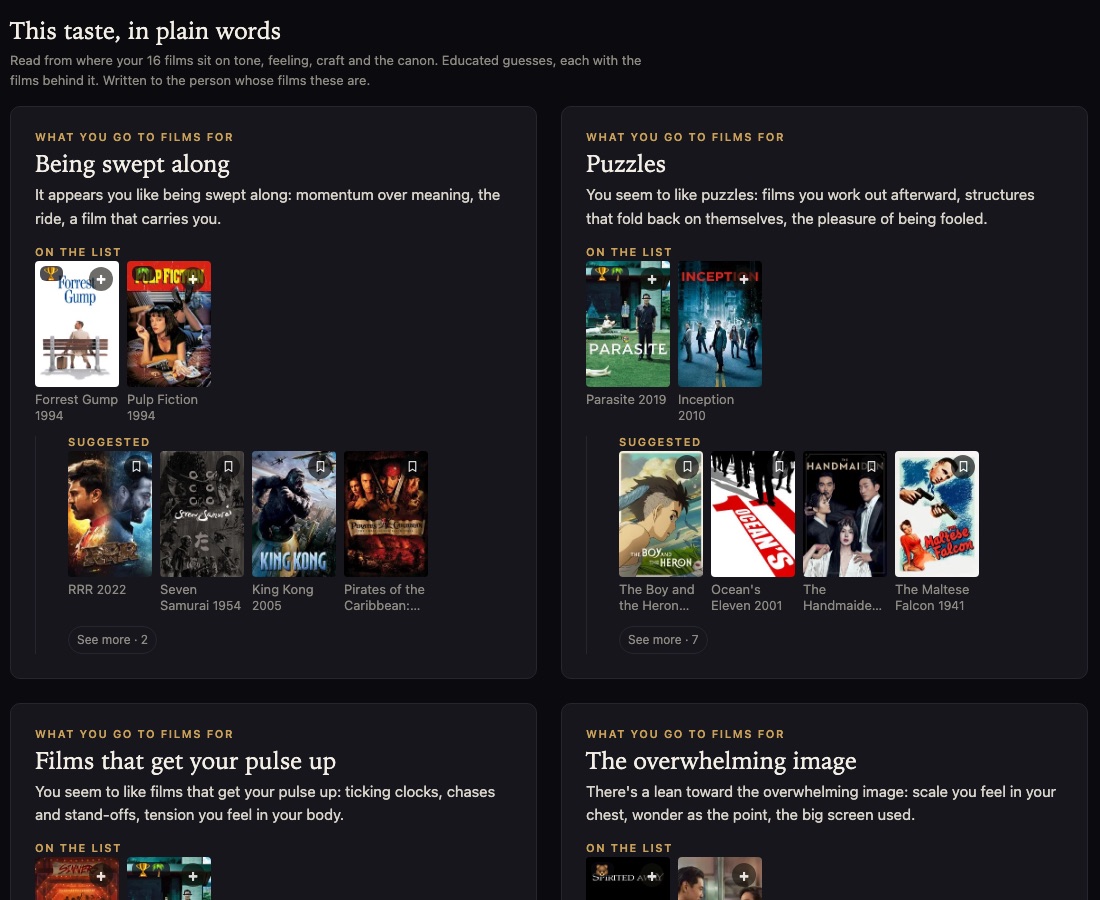
Sightlines is a film guide to more than 3,500 films. You bring your own films: a Letterboxd list or username, a Reddit thread, a CSV, or a screenshot of your top four or a shelf of Blu-rays. Sightlines writes a taste reading in plain words. It says what you go to films for, the tone you like, and how you like a film shot and written. Each claim names the films behind it.
The reading sharpens through choices. Sightlines puts two films from the same genre side by side. They differ in one quality, and you pick the one you would rather watch. You can answer any claim in the reading with "That's right", "Not me" or "Say more". A rejected claim stops steering your recommendations.
What carried over. Taste is a set of distinctions, not a list of favorites. Likelist found them in people: whose taste their friends trusted, and in what. Sightlines has no social graph. The AI reads the films themselves, their mood, craft and lineage, and says in words what your favorites have in common. That lets the personalization go past the recommendations into the experience: a reading of your taste, the runs of films your favorites belong to, and a short course written from the films you brought.
2. Personas live in the exchange: Klout to AI personas
Then · Klout, 2009
In 2009 I defined Klout's 16 influence types, starting from an original set of four. Each type was a persona: a pattern in how a person used Twitter and how their audience answered. I matched the types to activity: retweets, @mentions and @replies, volume, trending topics and followers. None of the types was a demographic. Each one described a way of showing up in an exchange.
Now · Personas Impersonated and Studio Critic
In my essay Personas Impersonated, I take up the debate over what we talk to when we talk to an AI. David Chalmers argues for a persistent interlocutor. Murray Shanahan, Kyle McDonell and Laria Reynolds argue for a simulator that role-plays characters. Anthropic's researchers describe an Assistant persona selected from many. All three look for the answer inside the system. I argue that a persona is something the user needs. It tells the user what to expect, how to behave and what register to use. In the essay's words: "Personas, then, are impersonated, and it is the user who impersonates them."
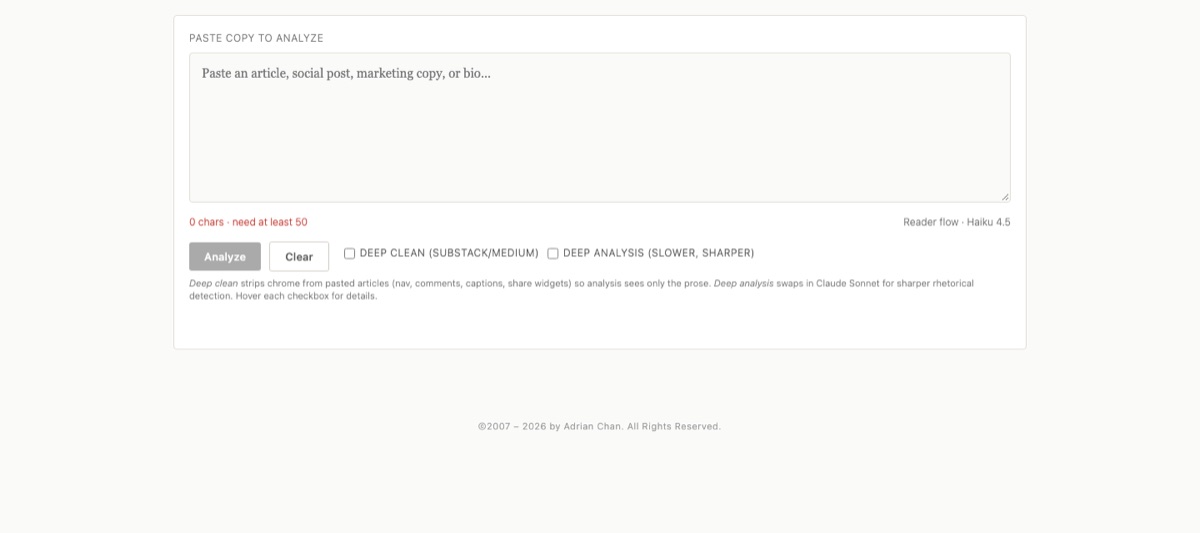
Studio Critic puts personas to work. You paste a text or a URL, and it reads the text for its reasoning, its rhetoric, its AI tells and its audience personas: who the writing is for, and who it reaches.
What carried over. At Klout, a persona came from behavior in an exchange, not from a profile. With AI, the persona again lives in the exchange, in the language and in how the person reading takes it up. That is where I design for it.
3. Content needs structure: content management to Studio Critic and Inquiring Lines
Then · Gravity7, websites and content management
Before the social web, Gravity7 designed, built and maintained websites and content management systems for more than 20 companies, among them Yoga Journal, Smith & Hawken, Sierra Designs, Reel.com, Webvan, NEC and Intraspect. Content management is mostly decisions about structure. What kinds of content exist? How do you break each kind into parts? How do the parts relate, and how do they get from a writer to a page?
Now · Copy Studio, Studio Critic and Inquiring Lines
Copy Studio and Studio Critic bring that structure to argument. I built them on modular reasoning: a library of modules, each of which finds one kind of move in a text, such as a type of claim, a rhetorical device, an AI tell or the audience a passage reaches. Studio Critic runs 52 of these modules over a pasted text and breaks down the arguments it makes. Copy Studio is the earlier version: you copy a prompt into the AI of your choice and read, critique or write marketing copy, social posts, articles and bios.
Inquiring Lines is content management at library scale. It holds about 3,000 AI research papers, each excerpted verbatim, about 3,000 synthesis notes, and more than 12,000 inquiring lines: research questions that connect findings across topics. Each content type has its own parts and its own links to the others. A pipeline takes a paper in, excerpts it, writes the notes, connects them to the library, writes new lines, and publishes to a staging site before the public one.
What carried over. A content model, a workflow and a publishing step, just as in a CMS. The difference is that AI now writes most of the content. So the design has to include the checks: excerpts that stay verbatim, notes that cite their papers, and sources opened before they are cited.
4. Conversation, presence and interest: social interaction design to conversational AI
Then · Social interaction design, from 2006; Principles, 2012
From 2006 my work was social interaction design: how people interact with each other through software. The features were likes, follows, feeds, threads, profiles and the small signals that show someone is there. The questions underneath were about conversation, presence and interest. What makes a person take a turn? What shows that someone is paying attention? What makes an exchange worth coming back to? In a 2009 audit of social sites I put it this way:
“Any social software service must engage users in talk: in talking about something, and to somebody. This talk must reveal something interesting about the member doing the talking, while also contributing the content of that talk to the site for consumption by others.”
I wrote up the field in Principles of Social Interaction Design (2012). The habit I learned was to design the experience the software carries, not only the interface that shows it.
Now · Conversational AI, interestingness and personal agents
In Conversation Is the Medium I argue that interestingness is the design goal proper to AI. The web captured eyeballs. Search matched items to queries. Social media captured attention. AI can engage the thinking a person is doing, turn by turn. The model generates language, and the user communicates. Those are different acts, and design works in the space between them.
Personal agents bring presence back as a design problem. An assistant that remembers you, acts for you and starts to appear among other people has to show it is there without demanding attention. It has to know you without seeming to watch you. Those are the same questions social software raised, now asked of a system that talks. My essay in progress, Interaction Design for AI, turns them into concepts, terms and heuristics for designers.
What carried over. The lens. With social software the interface was the venue and the interaction between people was the point. With AI the chat window is the venue, and the exchange between a person and a generating system is the point.
5. Teaching what to notice: curriculum to how-to-watch guides and film courses
Then · SPICE at Stanford, Scholastic and The Civil War videodisc
My first content work was educational. At SPICE, the Stanford Program on International and Cross-Cultural Education (1988, then 1989–1991), I published 12 curriculum units on US–Soviet relations and Eastern Europe. At Scholastic in 1993 I worked on early new media strategy and produced an electronic book on CD-ROM. At Illumina Productions I designed the content and wrote the teacher and student curricula for the PBS videodisc of Ken Burns's The Civil War, which won the NAB Crystal Award for best educational technology product.
Curriculum is design. It sets the order things come in, what a learner should notice, and which questions make them look again.
Now · Sightlines how-to-watch guides and film courses
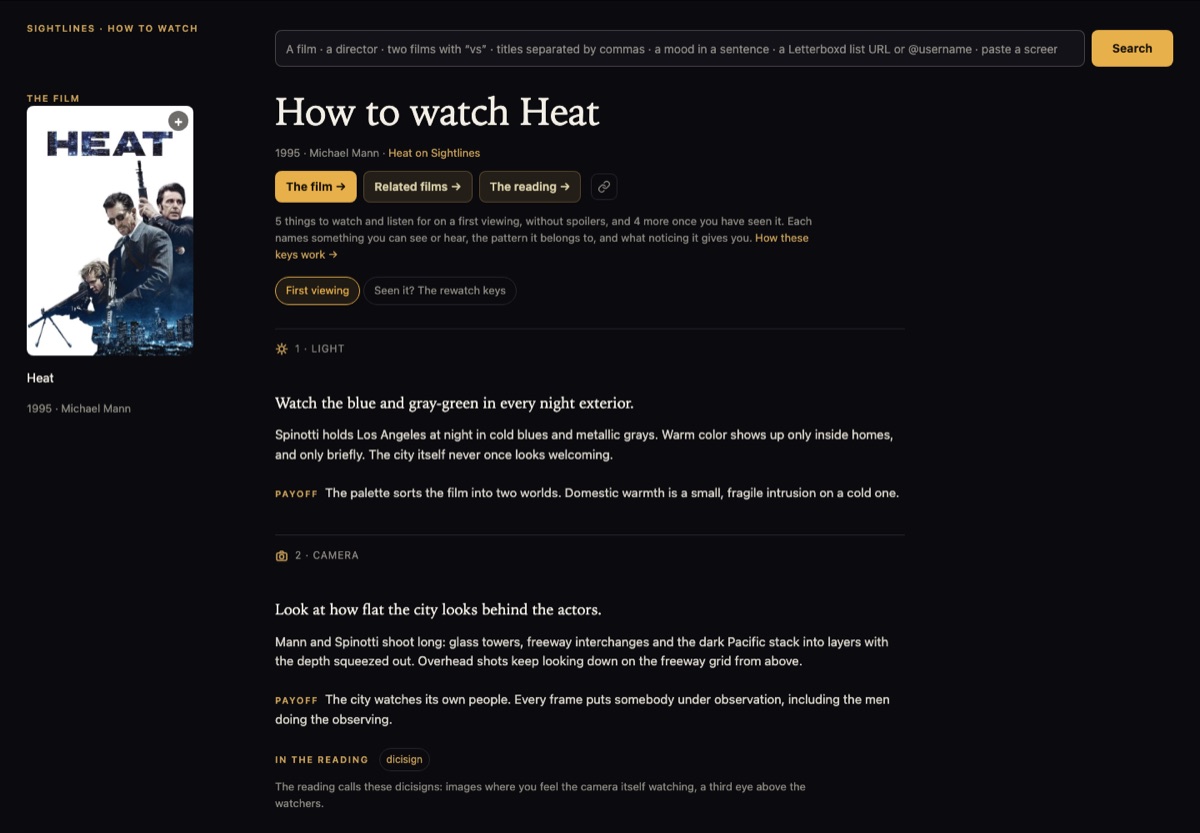
Sightlines has a how-to-watch guide for most of its films. Each one says what to notice in the camera, the light, the cutting, the sound and the staging. It also has 218 spoiler-free film courses, and it writes a short course for a visitor from the films they bring. AI writes the guides and courses. My part is what a curriculum unit always needed: the sequence, the questions, and a check before anything reaches a reader. Guides go through a spoiler review before they are published.
What carried over. A guide is useful when it changes what you see. That was the job of a teacher's guide to The Civil War, and it is the job of a how-to-watch guide to a film.
6. Every company wanted an app: Deloitte Digital to the agent moment
Then · Deloitte Digital, 2012–2017
I joined Deloitte Digital in the mobile-first years, when every company wanted its own iPhone app, iPad app and site redesign. I helped recruit and build a client-facing team of UX and CX designers. They carried client needs from the onsite consulting teams to the studio design teams. I also contributed to the firm's go-to-market for digital transformation.
The requests were about apps. The work was about customers. What did people need from the company on a phone? Which services should move there? And what had to change inside the company to make that work?
Now · The agent moment
Today, every company is working out what AI agents should do for its customers. The question has the same shape as before. It is not whether to have an agent. It is what the agent should do, and for whom. What should it say? When should it hand a customer to a person? When a person reviews what the agent did, how do we keep that review from becoming a rubber stamp? And what has to change behind it?
What carried over. A way of looking, not a project list. I have watched one wave of digital transformation from the customer side. Building Inquiring Lines and Sightlines showed me firsthand what current AI does well in a user experience and where it needs design. I bring both to the question every company is asking now.
The idea stays; the material changes
Recommendations, personas, content structure, conversation, curriculum and customer experience were design problems before AI. They still are. AI changes what the system can do with each one. It can read a set of films, write a guide, take on a persona or follow a question across 3,000 papers. It also changes what can go wrong, and that is where design comes in.
Essays, products and tools → · Inquiring Lines → · Sightlines → · Ways to work together →