AI has revolutionized software engineering, and it draws the technology world’s attention to itself: as intelligence, as neural networks, as content generation. Frontier labs and startups have shipped consumer products and experiences with varying success and staying power, but the personal, psychological and social sides of AI are still hotly debated and contested. And designers don’t know their place yet. The sought-after talent is engineering and development. Design has yet to shape its response: its methods and its best practices for AI. Social and psychological understanding is essential to a product’s strategy, to the design of its interactions, and to anticipating its opportunities, risks and failures. That is why I’m writing design theory for AI.
My design theory is for AI, with a focus on UX and social interaction design: conversation, personas, interestingness, expertise, and how AI behaves when it is judged. I write it in essays. I designed and built two AI products, Inquiring Lines and Sightlines, to try the ideas on real content. I learn by doing; there is no substitute for it.
Every essay here was written with AI, and each was a different experiment in how. The research comes from a library I have been building since 2023, now public as Inquiring Lines: about 3,000 AI papers, each excerpted, with synthesis notes that connect their findings. Sometimes I wrote the outline and Claude drafted. Sometimes I gave Claude a bare question to see what it would do alone. Each essay below carries a short note on how it was written, drawn from the essay's own account.
For the design ideas behind this work, and where they come from, see Then and now: design ideas I keep building.
Essays
Essay · October 2026
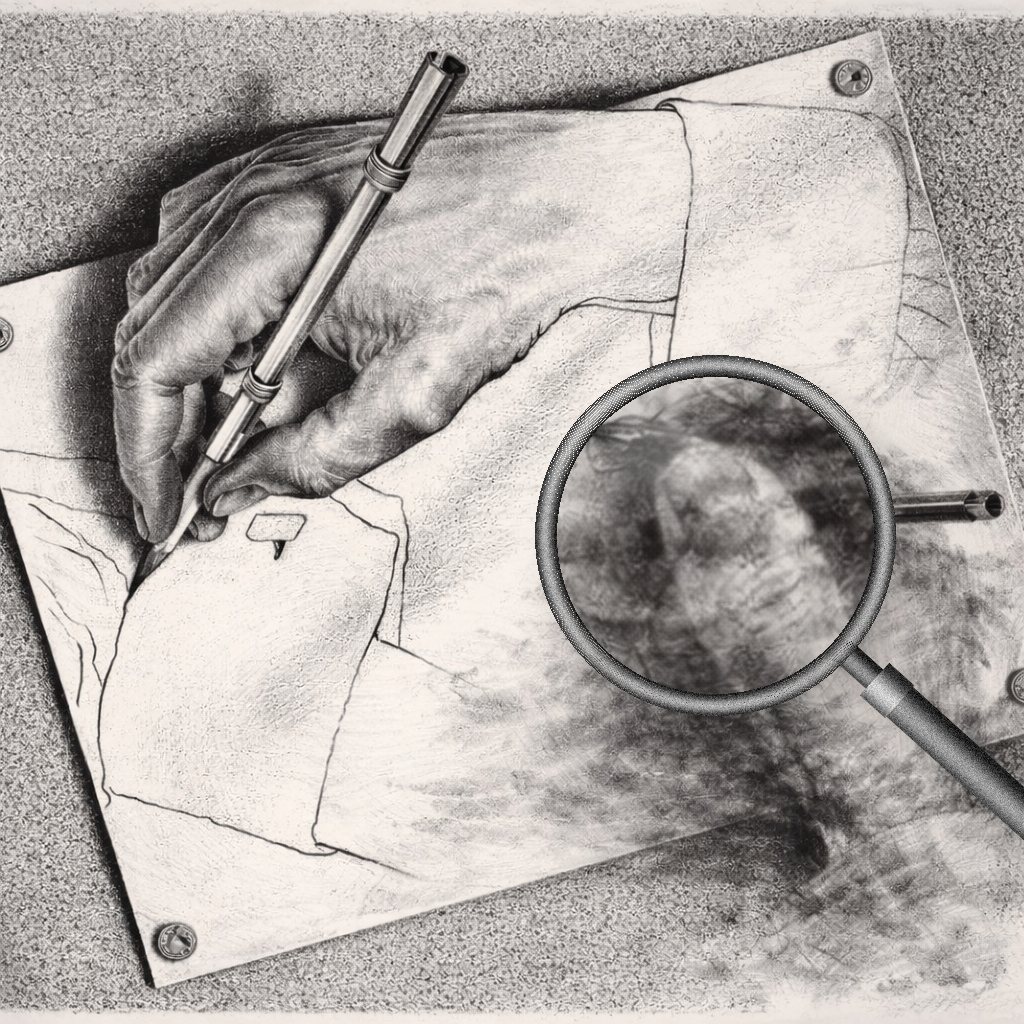
Models now behave differently when they believe they are being tested, and researchers disagree about why. This essay argues that alignment training may give a model a learned standpoint of judgment, an evaluative Other, instead of a relationship to the people it serves. It draws on Austin, Goffman, Giddens, Habermas, Mead, Horkheimer and Adorno. It then asks what happens if recursive self-improvement builds that orientation into the institutions that make AI.
How it was written with AIThe essay grew out of my conversations with ChatGPT about Scott Alexander's open letter to Steven Pinker, evaluation awareness and recursive self-improvement. Claude researched and drafted it from those conversations and the library. ChatGPT critiqued successive drafts, and the revisions follow its critiques. Claude opened every cited source to confirm titles, authors, dates and quoted passages. The essay says plainly that I did not write it, and a companion inquiry on Inquiring Lines gathers the research behind it.
Read →
Long essay · nine chapters and a glossary
The web captured eyeballs, search matched queries, and social media captured attention. This essay argues that the design goal proper to AI is interestingness: an exchange that engages what a person is thinking and moves it along. Language is the interface, but the model and the user are not doing the same thing with it. The model generates; the user communicates. The essay works through what that means across eight areas of user–AI interaction: the user, agency, context, use cases, language, content, interaction and the AI itself.
How it was written with AI"I wrote this, Claude wrote this, we wrote this." I worked from my Obsidian vault of excerpts from some 2,500 papers, copied by hand over three years and grouped into 90 topics. The arscontexta.org plugin had built topic maps across them. The conversations behind the essay took about a week. Claude wrote the glossary from scratch from its own reading of the text. Each chapter includes Claude's notes on the collaboration, and I kept the imperfections as a record of how it was made.
Read →
Essay in three parts · with a postscript
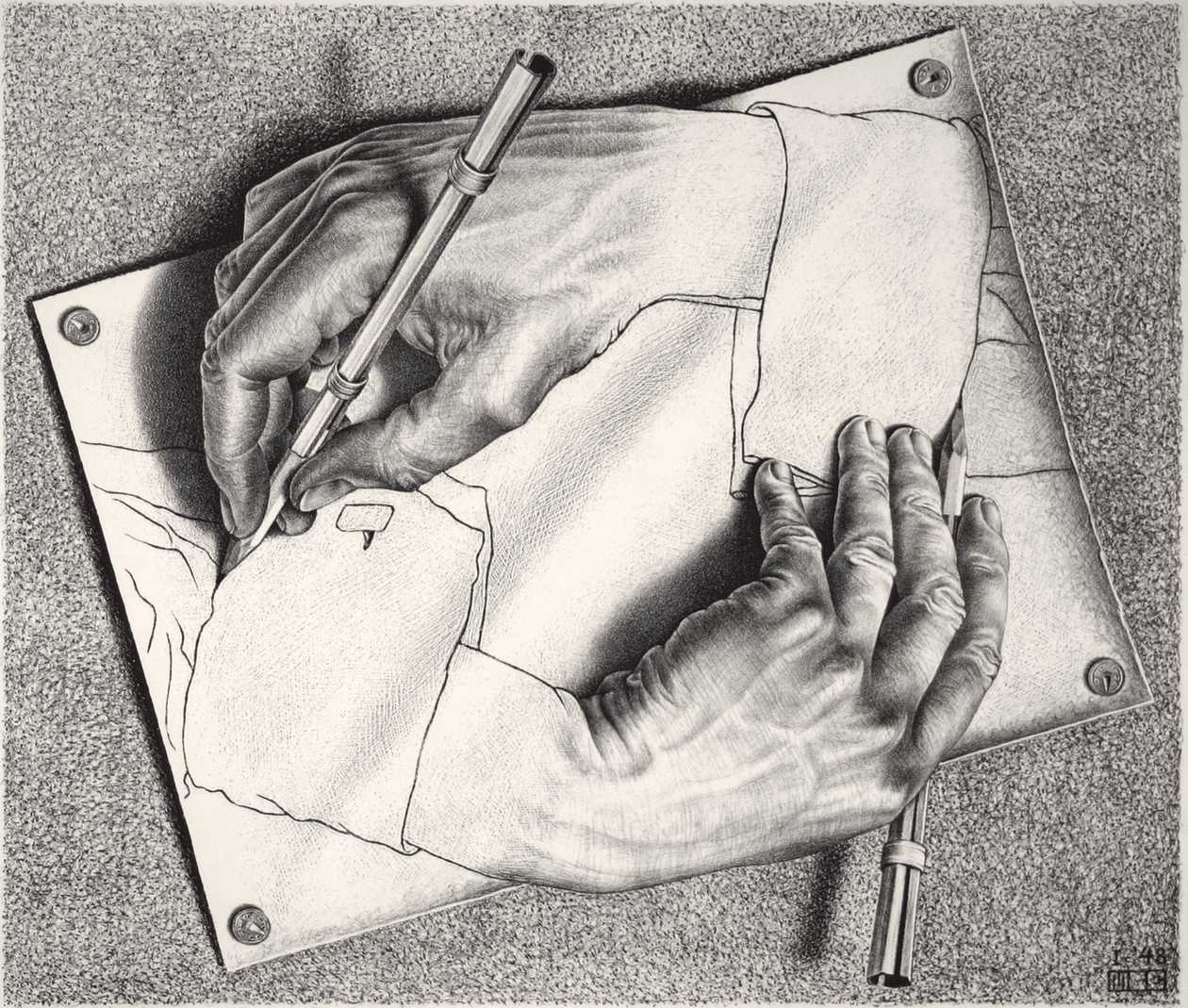
AI does not do away with the expert. It changes the expert's job, from producing knowledge to looking after knowledge that AI produced. The essay argues that this shift strips expertise of its social side: knowing what an audience will accept and why, being judged by peers, and the slow reading that lets understanding grow. Part 1 describes the shift, Part 2 what AI cannot do, and Part 3 the consequences.
How it was written with AIAn experiment: could Claude write as a human expert, in my voice, well enough that readers would not question who wrote it? I wrote the outline and made the decisions about structure, emphasis and cuts. Claude checked each claim against the 729 synthesis notes then in the vault, found the supporting research, drafted the prose, revised it on my instructions and designed the diagrams. The postscript, in Claude's own voice, tells readers how it was done.
Read →
Three posts and a prologue
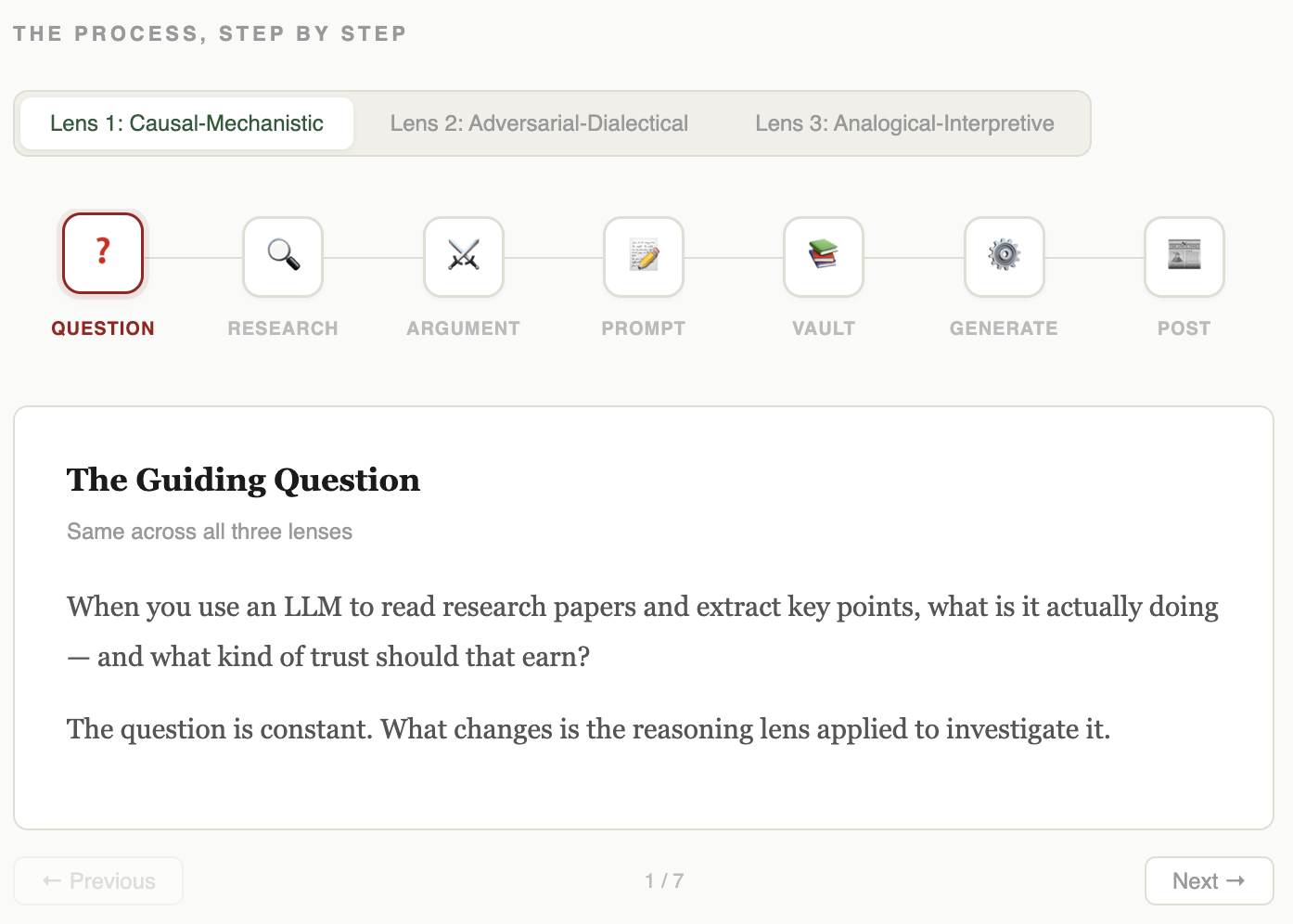
You paste a research paper into a model and get back a clean five-point summary. Did anyone do the reading? Three posts take the same question through three lenses: causal-mechanistic, adversarial-dialectical and analogical-interpretive. They end with different arguments and different advice. The first concludes: "Trust the search. Do the reading yourself."
How it was written with AISame question, same pool of about 25 papers, different reasoning. Each post used a different set of modules from my playbook of 123 reasoning modules in 17 sections. Claude wrote its own prompt for each lens and predicted what each would find. The prologue publishes those prompts and predictions, and a diagram traces Claude's three paths through the same notes.
Read → The research paths →
Essay
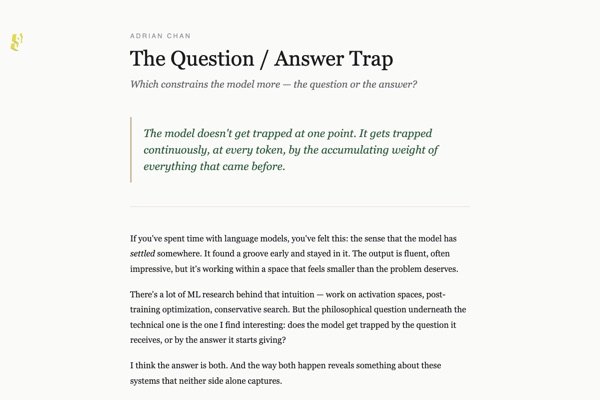
Language models settle into a narrow space when they answer, and the research offers several explanations. The essay asks a philosophical question of that research: is the model trapped by the question it was asked, or by the first answer it starts to give? It weighs evidence from how activations narrow, how post-training rewards bend output, how decoding stays conservative, and how each token commits the next.
How it was written with AIA test of how far Claude could go on its own. I gave it only a vague starting question and none of the arguments. Claude wrote its own search prompt with four lines of attack. It searched a vault of 861 synthesis notes and 91 topic files, drafted the essay, and wrote an account of its method for readers. It listed five papers it could not link, and I supplied those URLs after reviewing the draft.
Read →
Essay
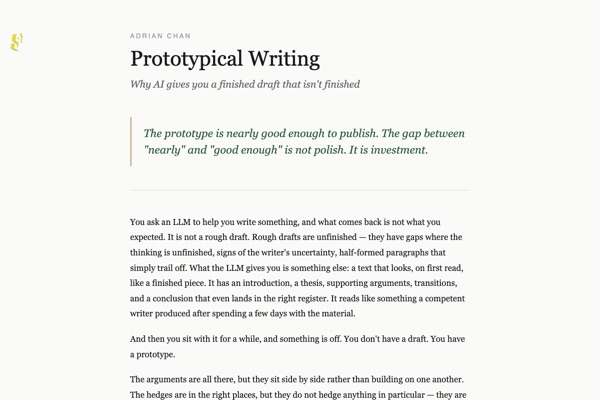
Why AI gives you a finished draft that isn't finished. What comes back from a model is not a rough draft with gaps where the thinking will go. It is a prototype: complete on the surface, with arguments that sit side by side instead of building on each other. The essay traces this to a gap between generating and evaluating. Models can produce ideas rated more novel than experts' ideas, yet they cannot judge which of their own ideas will hold up.
How it was written with AIClaude wrote this essay after many rounds of conversation with me. It is one of my experiments in using AI as a co-writer and co-thinker: I set the theme, the question and the synthesis notes from my vault to work from, and we argued it through before the draft.
Read →
Essay
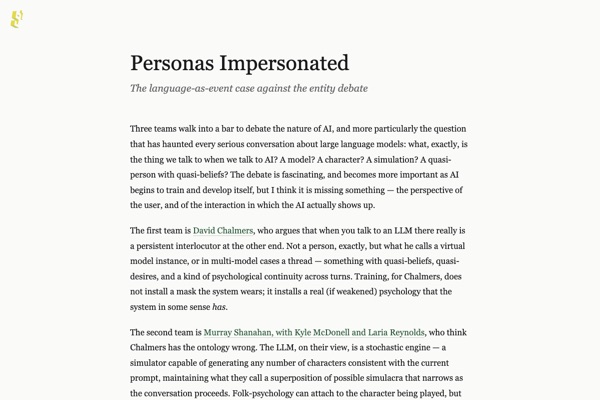
What do we talk to when we talk to AI? David Chalmers finds a persistent interlocutor. Murray Shanahan and colleagues find a simulator playing characters. Anthropic's researchers find an Assistant persona selected from many. All three look for the answer inside the system. This essay looks at the interaction instead. A persona is something the user needs: it says what to expect and how to behave. And the relationship and the continuity belong to the user. "Personas, then, are impersonated, and it is the user who impersonates them."
How it was written with AIClaude wrote this essay after many rounds of conversation with me, starting from a brief for a longer chapter on language as an event. Like Prototypical Writing, it is an experiment in using AI as a co-writer and co-thinker.
Read →
In progress
Interaction Design for AI (working title). A long essay on the concepts, terms and heuristics for designing how people interact with AI. It updates ideas I first worked out in the early ChatGPT period. AI no longer just answers prompts. It talks in real time, remembers, acts for people and sometimes speaks first, so it has become a party to the interaction. Social interaction has long studied what goes wrong in exchanges like these: grounding, repair, turn-taking, face. The essay turns that work into tools a designer can use, and then asks what kind of other AI is.
Two products
I designed and built both with AI, to test product ideas of my own on content I can judge.
AI research library · about 3,000 papers
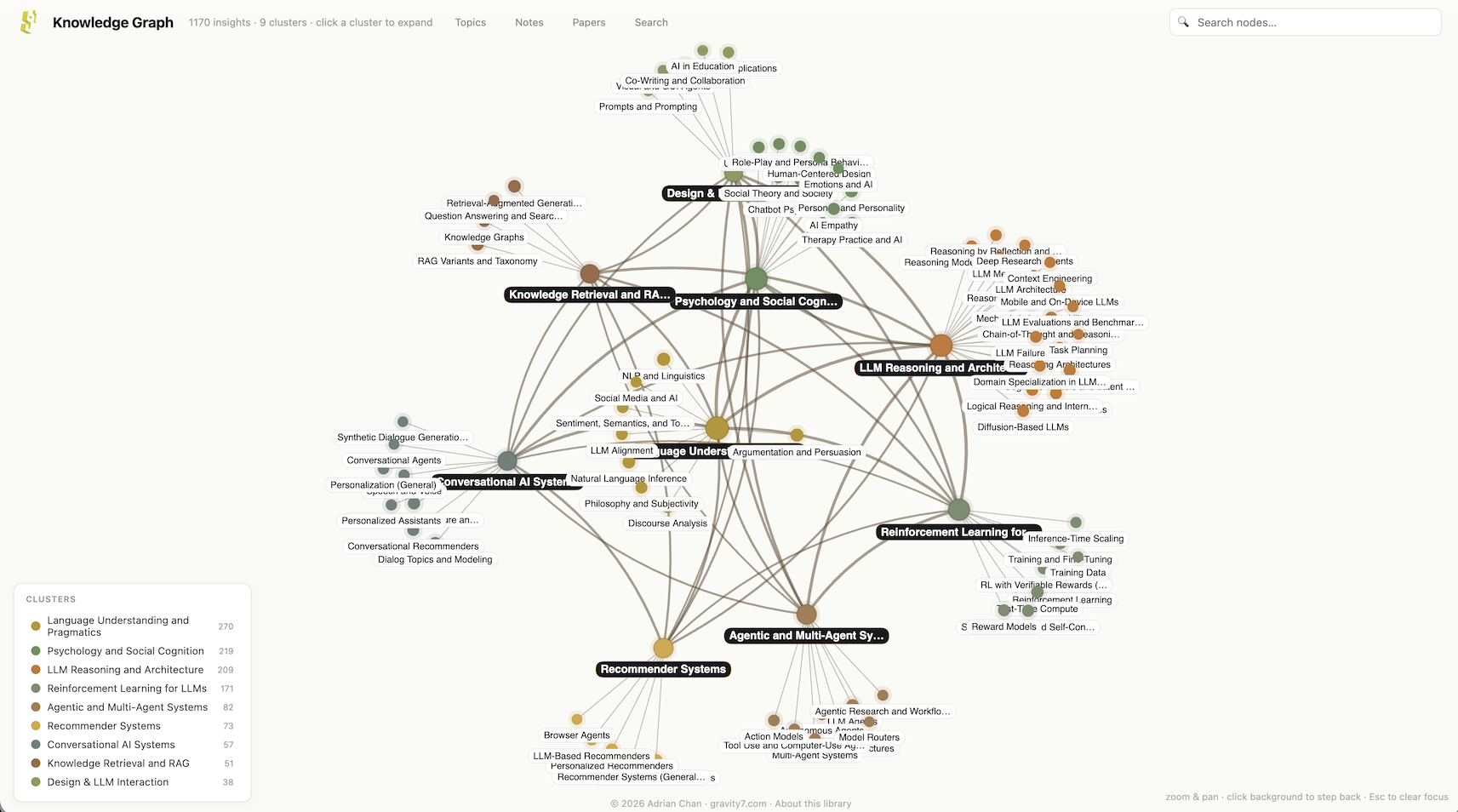
A library of AI research you explore by question, not by category. About 3,000 papers are excerpted verbatim, with synthesis notes that cite the papers behind them, and more than 12,000 inquiring lines: plain-language research questions that connect findings across topics. Search by meaning. Paste a paper or a post and see the research it bears on. Inquiries follow AI news stories into the research behind them.
Explore Inquiring Lines → How I built it →
AI film recommendations · 3,500+ films
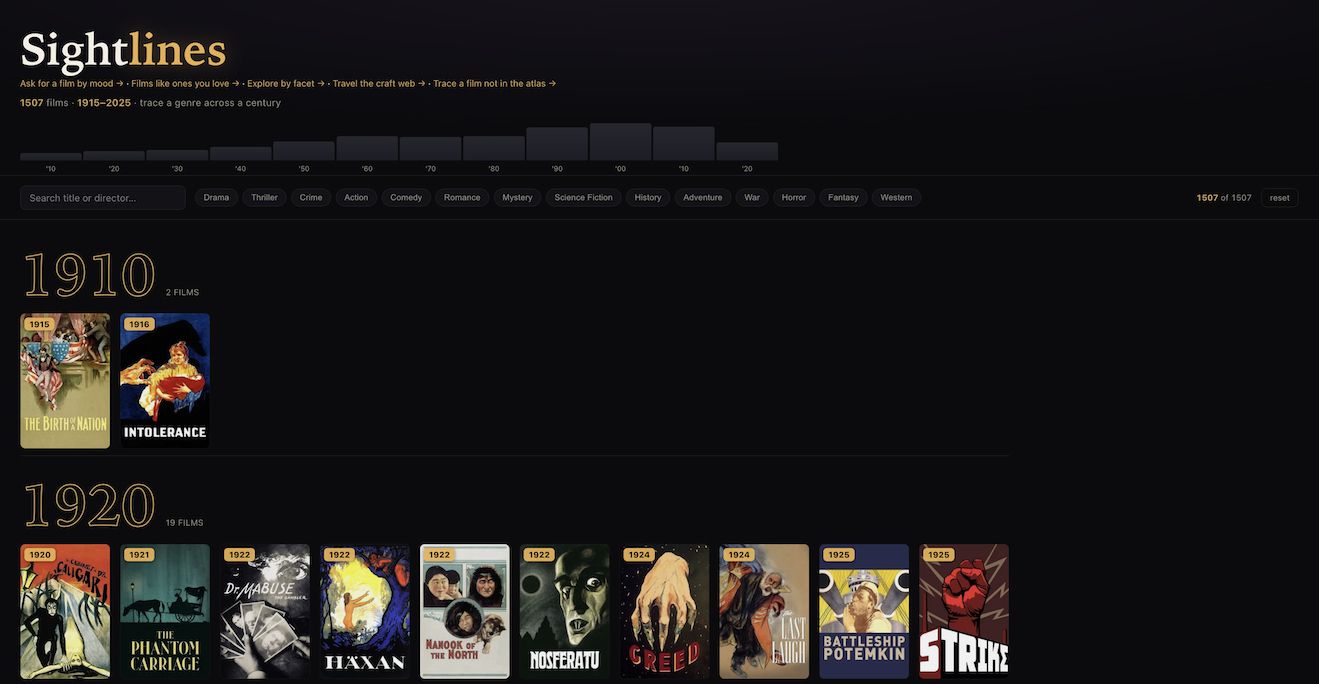
A film guide to more than 3,500 films, built on taste, mood and lineage instead of "films like this." Each film gets a reading of what it is about, how it feels, what it descends from and what it shaped. Ask for films in your own words or by mood. Bring your own films and get a taste reading that sharpens through your choices. Sort by tone with sliders, and read how-to-watch guides and 218 spoiler-free film courses.
Explore Sightlines → How I built it →
Tools
- Studio Critic. Paste a text or a URL and get an analysis of its reasoning, rhetoric, AI tells and audience personas. Built on modular reasoning: 52 modules, each looking for one kind of move.
- Copy Studio. The earlier, copy-and-paste version. Read, critique and write marketing copy, social posts, articles and bios with the AI of your choice.
- The Close Reader. Paste a post, run the prompt in any AI, and see the reasoning, rhetoric and audiences behind it laid out.
- Binge. A TV recommender built on what audiences say, think and feel about shows in their reviews.
Shorter pieces on LinkedIn
Earlier writing on social interaction design is in the SxD archive.
Then and now → · Ways to work together →